Faith-Hope “Unseen” versus “Seen”

I was scrolling through my Instagram, which is 90% cat videos, gardening, and travel sites — all of which make me very happy — and I came across one of the many accounts about Italy that I follow. 

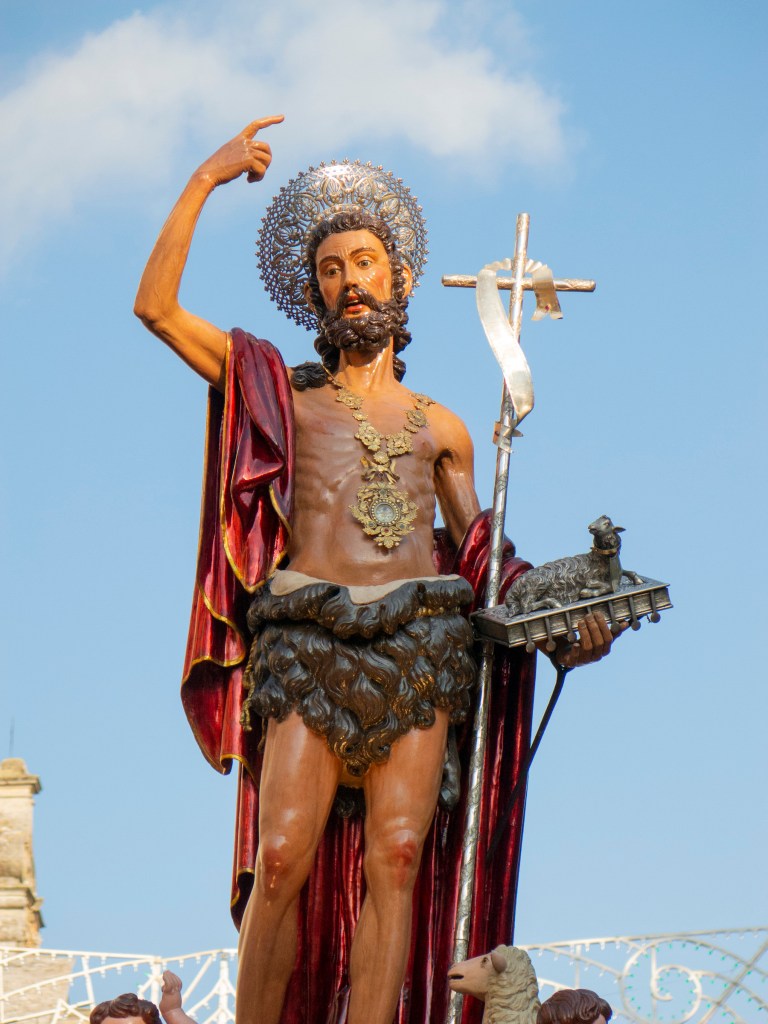
The post was about how Firenze celebrates the feast day of San Giovanni Battista, aka St. John the Baptist, patron saint of Firenze, today, June 24th

Many acts of celebration take place in the days leading up to the festa, and an entire day of festivities takes place on the actual saint’s day. You can read about some of them here:

Visit Tuscany

https://www.visittuscany.com/en/ideas/june-24th-in-florence-san-giovannis-celebrations/#:~:text=If%20you%20ever%20come%20to,patron%20saint%20of%20the%20city.

https://www.theflorentine.net/2025/06/18/how-florence-is-celebrating-san-giovanni-patron-saint-day/#:~:text=Florence%20celebrates%20its%20patron%20saint,through%20the%20entire%20historic%20centre.

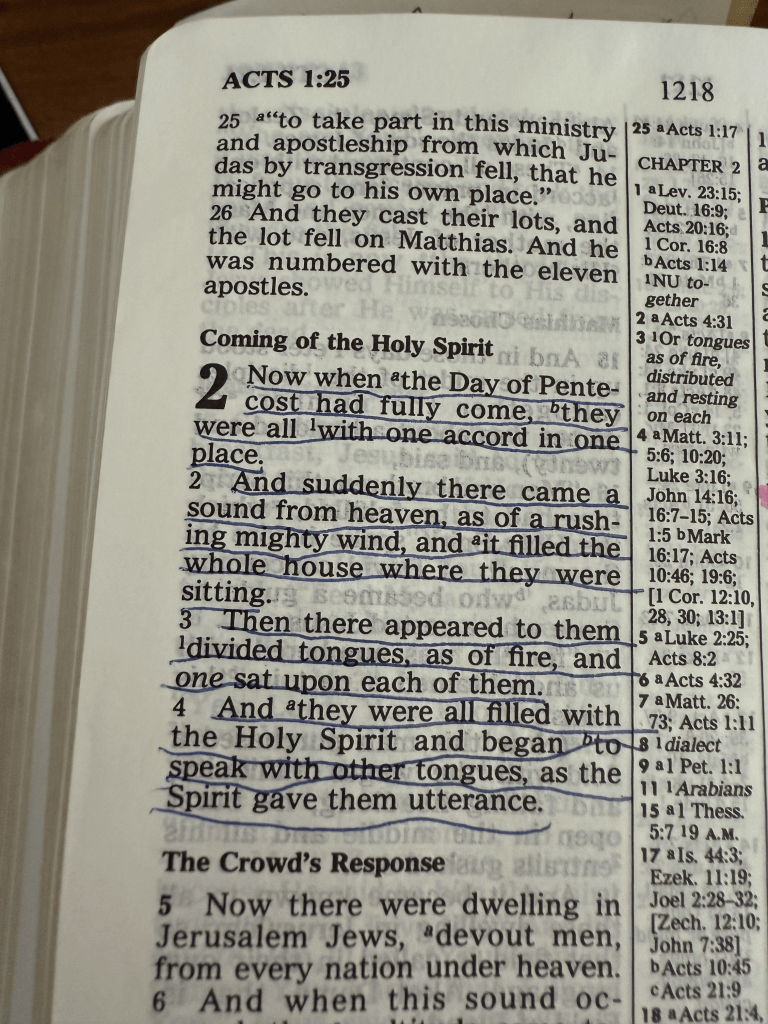
Not being Catholic, I have never given much thought to feast days or patron saints until I started teaching and spending time in Italy. Growing up as a Pentecostal/Evangelical Christian, anything decorative bordered on idolatry. Pentecostal, briefly, is part of the Evangelical movement based on the day of Pentecost. Pentecost is believed to be the day that the Holy Spirit descends on the disciples. The event is found in Acts chapter 2. 

“And they were all filled with the Holy Spirit and began to speak with other tongues, as the Spirit gave them utterance.” 

Acts 2:4
This is the religion of my family. Speaking in tongues. Dancing in the spirit. Tent revivals in the sweltering summer heat of Kentucky. Church people being consumed by the spirit and passing out. Though I am not sure if the passing out was from the spirit or from the oppressive heat of tent revivals (my Grammaw always had a church fan in her purse), or the random appearance of a snake in the hands of someone demonstrating the power of the Lord to suppress Satan (my Grammaw did not have a snake in her purse).

The Pentecostal churches I know were devoid of decoration and very simple because, like Puritans and Congregationalists, people felt that decoration and ritual distracted from their personal relationship with God.  And there were never images of anyone in our churches. No Mary, No saints. No Christ child, or Jesus at all, really.  We had images of Jesus, on the cross or as a young man, but those weren’t hung in church. 
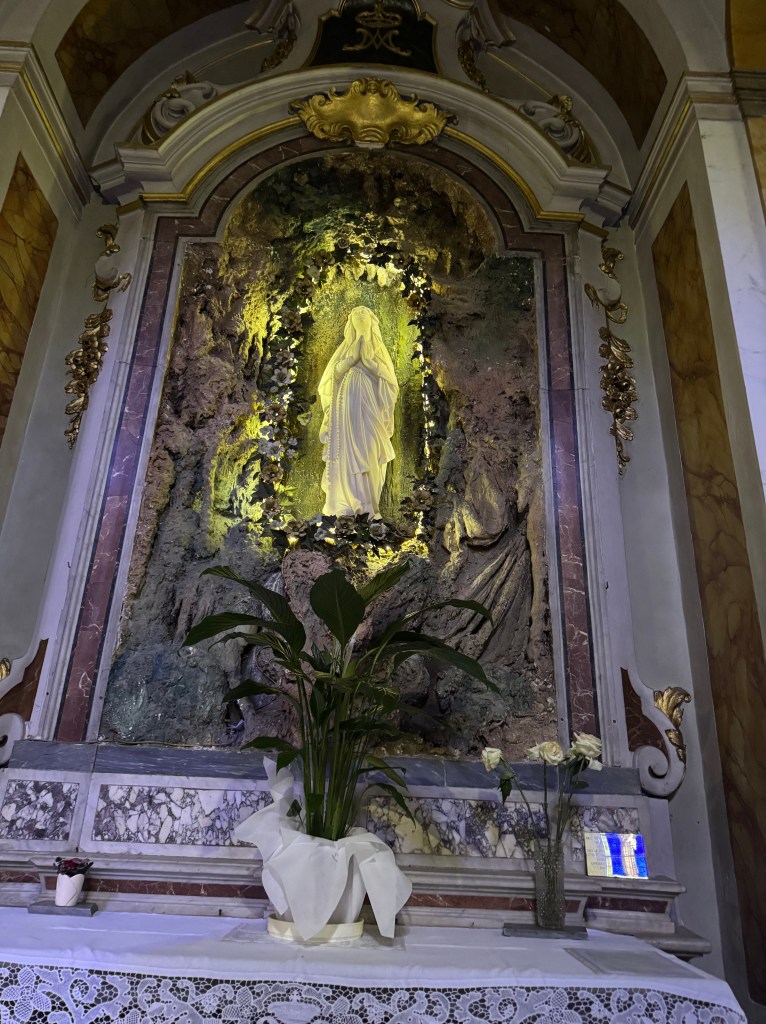
Photo credit to me. This is an altar inside Chiesa dei Santi Pietro e Girolamo o San Pietro Apostolo-May 2025

And we certainly didn’t have a home altar. It’s impossible not to appreciate the many murals and altars erected in nearly every (probably every) neighborhood in every city in Italy.

Some of these altars or murals are simple. Some are very grand. Many are of the Madonna and Child, but many are of saints. 

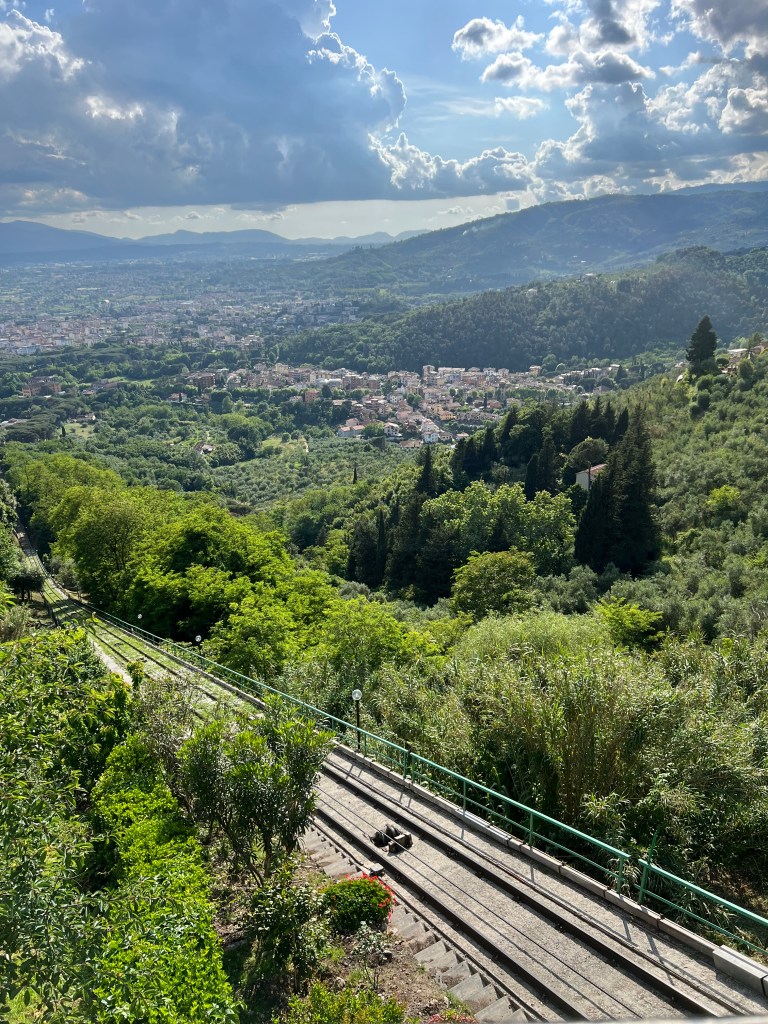
Even on the side of the Funiculare hill up to Montecatini Alto there was a small altar to the Madonna and Child. I missed taking a picture of it and would have missed it altogether if we hadn’t noticed the lovely Italian woman standing in front of us on the car balcony hadn’t thrown a kiss to the Madonna as we passed. 
And, as we learned in Napoli, you could say that the altars and murals reflect a slightly modern take on a holy trinity—Madonna, Maradona, and Sophia.

As I read about the upcoming celebration of San Giovanni Battista, I was also reminded of the patron saint of Napoli, Saint Januarius, better known as San Gennaro. Saint Januarius is the Roman/English name, and San Gennaro is the same name in Italian.

I have visited many churches and basilicas throughout Italy, and many of them display relics, with heads, fingers, and blood being among the most treasured. The same is true of the cathedral in Napoli. However, this one is uniquely different because the Chapel of San Gennaro, where the relics are kept, is the only chapel inside a cathedral in Italy that does NOT belong to the Vatican.

 If you want to read more about the amazing history of San Gennaro: https://www.holyart.com/blog/saints-and-blessed/the-story-of-san-gennaro-the-patron-saint-of-naples/

Maybe that’s why I was fascinated with San Gennaro, or maybe it was the story of his blood liquefying three times a year—on September 19 (his feast day), on December 16 (which marks the day that San Gennaro is believed to have saved Napoli from the eruptions of Mount Vesuvius) and on the first Sunday in May. This day in May honors the day San Gennaro’s relics were transferred to the chapel. 
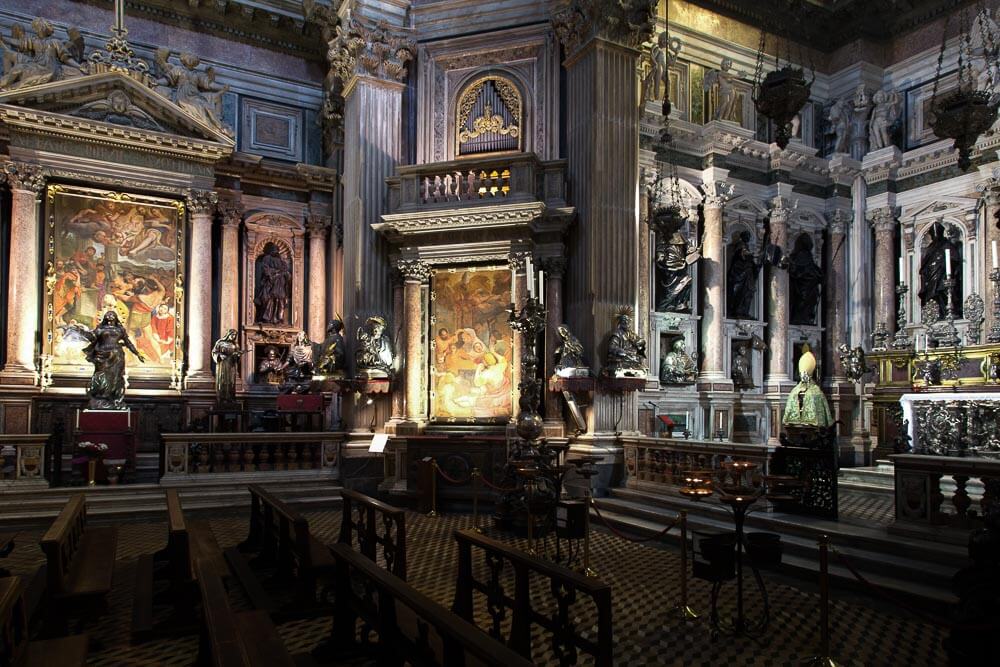
As part of the ritual of liquefication, the vials, or ampoules, of blood are brought out and placed in a reliquary for the Bishop of Napoli to present to the crowd. Hundreds of people pack the chapel, the cathedral, and the streets of Napoli to witness the miracle. After prayers led by the Bishop of Napoli and repeated by the devote people, the blood liquefies. The people of Napoli take the liquefaction as a sign of good fortune and prosperity to come. When the blood does not liquefy, the event foreshadows a precarious and ominous future. 
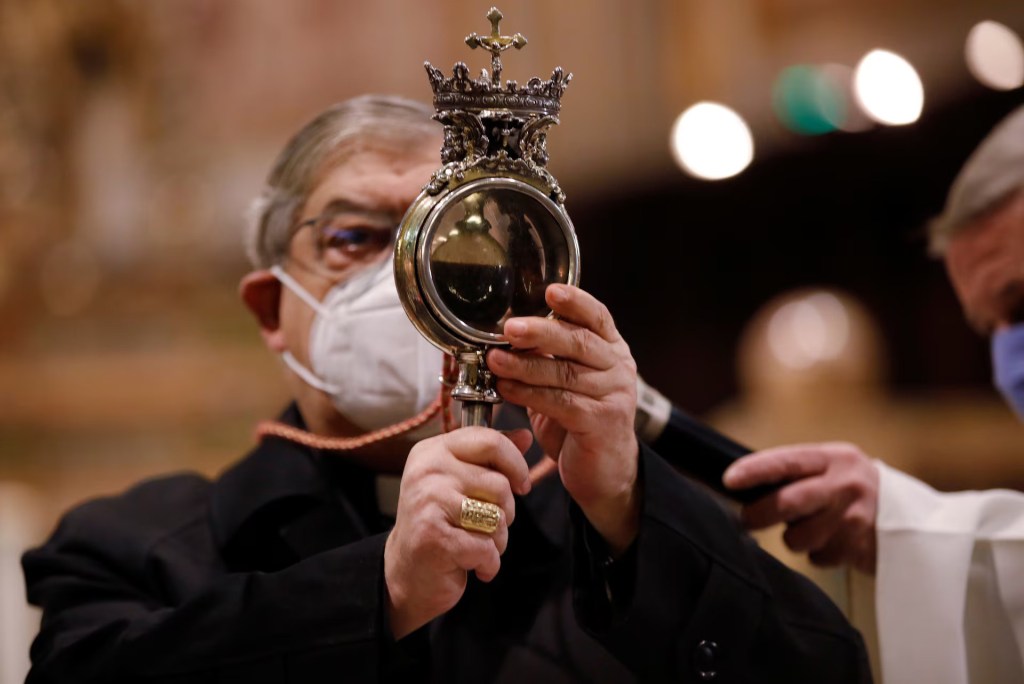
There are several times the blood did not liquefy and plagues, wars, and earthquakes followed. Most recently, the blood failed to liquefy on December 19, 2020—believed by many to be a sign of the continuation of COVID and the financial crisis that resulted.

Read more: Blood of Naples saint fails to liquefy in what some see as a bad omen. https://www.reuters.com/article/lifestyle/blood-of-naples-saint-fails-to-liquefy-in-what-some-see-as-bad-omen-idUSKBN28Q2UX/#:~:text=Scientists%20say%20the%20substance%20inside,killing%20more%20than%203%2C000%20people.

The reliquary stays on display for eight days. People are invited to touch and to kiss the sacred vessel holding the blood of their beloved saint. I love the entire ritual. I love the glamor of the Chapel of San Gennaro. I love the treasures and relics. I love the history. I love the devotion. And, I love the faith and belief of the people. 

I claim no religion or denomination now, but I had plenty of it growing up. Now, as I learn to appreciate cultures and religions from all over the world, I am reminded of things that have stuck with me from childhood. Although I have separated myself from religion, there are a few guiding principles that I have learned, which I feel speak more to humanity than to religion. The faith of those devoted to San Gennaro brings back memories of many sermons, and also feels very relevant to all of us today. And seeing the news of San Giovanni’s feast day, I was thinking about how these feast days give people hope. Something I need more of lately. 

I got out my Bible. It’s not kept in any reverent place in the house like the Puritans. It’s just on a shelf of what I call keeper books. In fact, it was squashed between two novels by Louisa May Alcott.

I dug it out because I was reminded of a scripture my Papaw used so often in sermons.

“Now faith is the substance of things hoped for, the evidence of things not seen.”

I confess I had to Google it first because I only remembered it was in the New Testament, but I had no recollection of which book or verse. Turns out, it’s Hebrews 11:1.

I also struggled to remember my Papaw’s voice and his explanations for the relevance of this scripture. I still don’t remember. And after trying to force myself into the words and explanations of this in the past, I let it go. Because, like my religion and denomination, I’ve let that go too. I look at these scriptures with new eyes now. It’s important for me to use the knowledge and understanding I have gained since those early memories. Though my Bible is filled with notes in the margins, memories on scraps of paper from many years, earmarks for places I have no recollection of making, and strange tidbits….
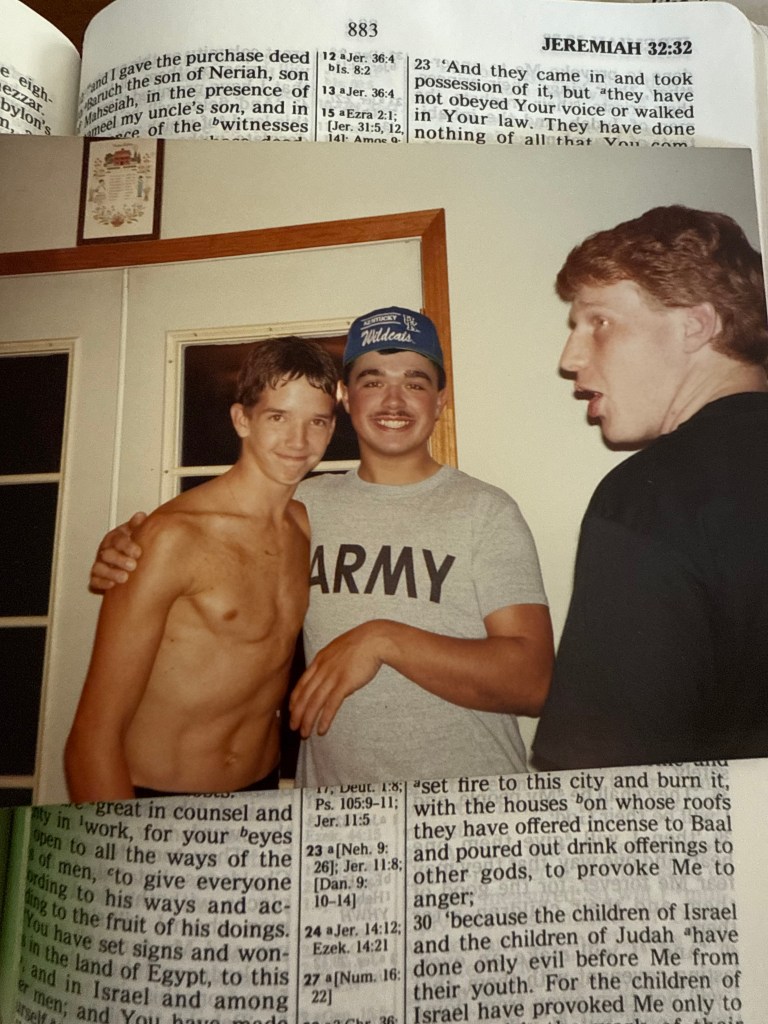
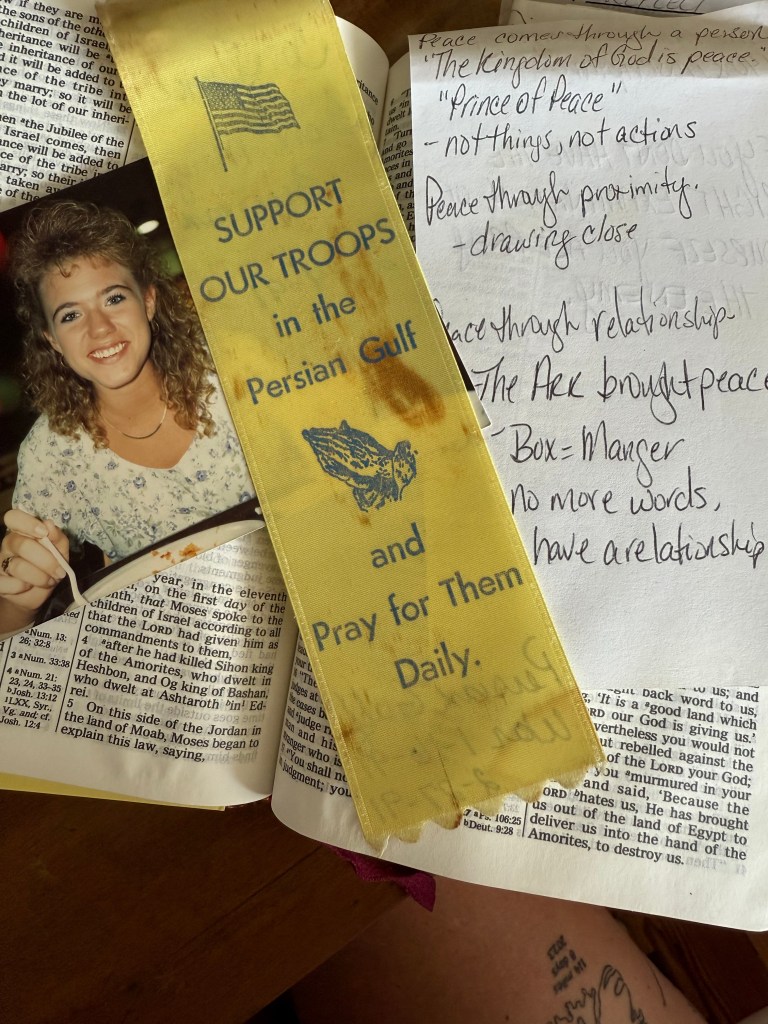
…it is like any other book to me in that it provides a starting point for making sense of things in my own world.

I used the reference to other scripture listed in the center concordance that sent me to Romans 8:24.

While I was searching for the other scripture, this was the one I was meant to see: Romans 8:24-25.

“For we were saved in this hope, but hope that is seen is not hope; for why does one still hope for what he sees? (8:24) But if we hope for what we do not see, then we eagerly wait for it with perseverance. (8:25)”

My Scorpio tail went up almost immediately. It happens when I feel the need to defend myself or someone or something else, and it also happens when I feel challenged, as if I need to prove myself or prove something to myself. My response also made me smile, because this is the exact feeling I would get sitting in graduate school when some theory, concept, or argument challenged me. And those are the moments I knew would lead to research and revelation.

As I read and re-read these passages, and those before and after, I was irritated by the ideas here. 

“but hope that is seen is not hope, for why does one still hope for what he sees?”

But, this is suggesting a sort of blind hope! I have to keep in my mind that this book, like all others, is arguing from a specific place. And here, in the Bible, this is about trusting in the Holy Spirit—which we cannot see. The hope, this unseen hope, equals belief in the Holy Spirit. And that is fine.  I can still appreciate this concept. But….
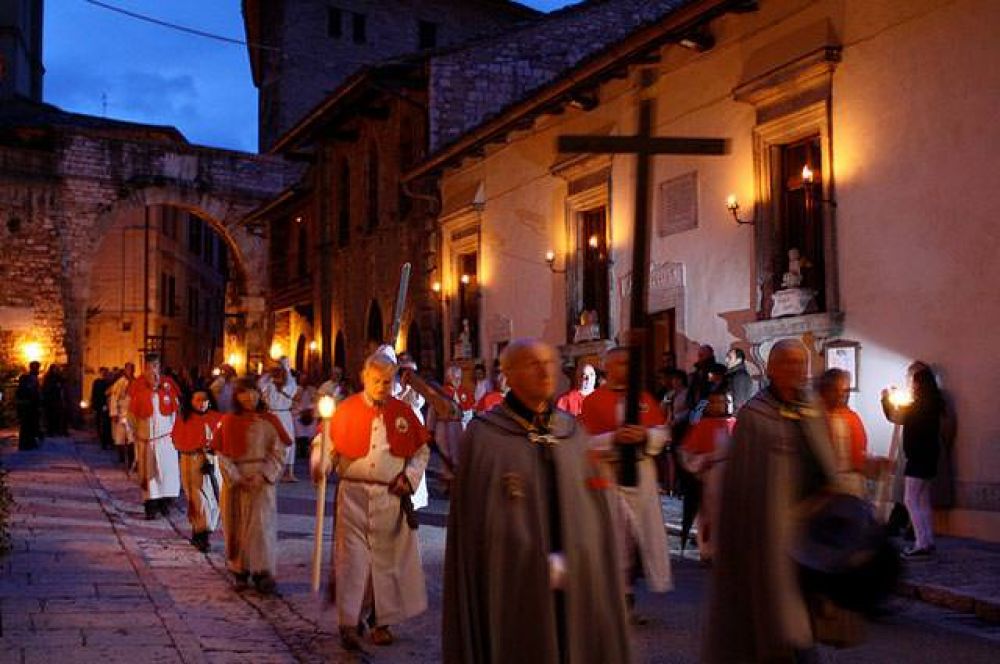
… the rituals on feast days of saints are a sort of seen hope. Maybe because I’ve fallen for all things Italian, but more because I’ve learned to understand things in my own way, these processions, relics, and rituals bring hope to people. I still try to work out the divide between the religion of my childhood—the plain, unadorned, simplistic church—and the chapels and cathedrals and basilicas of other religions with their precious stones and metals, and their glamorous altars. 

These beautiful places of worship and these rituals inspire both devotion and faith. These are things that can BE seen and are part of what I believe gives them hope. I don’t know much about their religiosity, and I am likely missing a real and fervent explanation for the connection. But, I am making sense of it in my own way.

Having studied the Puritans and the formation of the Congregational Church for many years, their goal was to remove the adornments and reliquaries that these men believed led people away from God, because they reflected the corruption of the Catholic Church in selling salvation or favor with God. And I get that. After all, some of the most beautiful chapels in Italy were funded by wealthy families hoping to win forgiveness from God.

Consider the beautiful Arena Chapel, in Padova, Italy. It is also known as Scrovegni Chapel because it was paid for by Enrico Scrovegni.
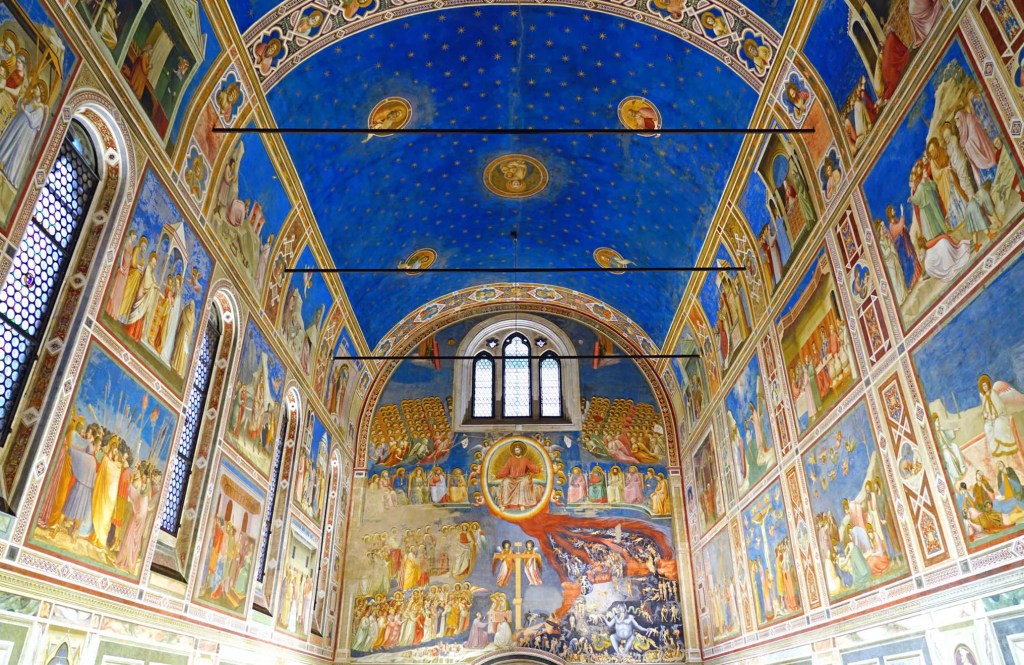
Photo credit: https://www.italia.it/en/veneto/padova/things-to-do/scrovegni-chapel-in-padua

Enrico Scrovegni came from a long line of moneylenders, not the most noble of professions during the Medieval period. His father was depicted in Dante’s Divine Comedy as one of those cast into hell to burn for the sin of ‘usury.’ As a means to save himself from a similar fate, Enrico hired Giotto di Bondone to paint the frescoes of the chapel (and possibly design the chapel itself).

No doubt there was an attempt to buy salvation here. But I won’t judge anyone else’s motives, not even Enrico Scrovegni. I like to think that people who pay for a chapel or even those who celebrate feast days have a pure heart. I like to think that the devout people of Napoli, who crowd the chapel, the cathedral, and the streets, are a hopeful people. I imagine them waiting to kiss the reliquary of liquefied saint’s blood, perched on the pews and rubbing their rosaries and praying. I imagine that they see what I see…shining gold, glittering jewels, blindingly bright marble, the sparkling Bishop’s mitre, and the gleaming crozier. And, they, like me, are hoping.

I believe you can draw hope from the unseen and from the seen. I need to believe that because “faith is the substance of things hoped for,” and hope seems to be in short supply these days. Hope seems to be dwindling.

And what happens when the hope is gone? What faith is left if there is no substance?

I’ll take hope from wherever I can find it—seen or unseen. And I like that rituals and iconography and relics provide hope. I don’t know if my boys, who also profess to be of no religion, have ever been in a Catholic Church before. But as they walked out of Chiesa di San Michele in Foro and the Duomo di San Martino in Lucca, they remarked on how they could now understand why some people went to church. They were moved by the visible devotion of murals and altars and the sight of people praying their rosaries, even among the gawking tourists. 

After all this thinking and writing, I know I won’t remember which book or verse these scriptures are in. What I will continue to think about are memories of how my Papaw, who I thought was so religious and so devout, struggled with understanding and accepting his own faith in himself, in God, and, I think, his faith in others.

I like to think that the faith within my boys was fueled by what they saw and what they felt in those places. What they saw was hope. It wasn’t unseen. And I hope they carry that with them and that it continues to fuel their faith. Religious or not, I have faith, and I think they do as well, in a world where we can accept and love the things and the people we encounter, whether we understand them or not. 

And I hope that the feast day of San Giovanni brings a similar hope to the people of Firenze today. Buona festa, Firenze! Grazie a Dio!
The Place That Built Me

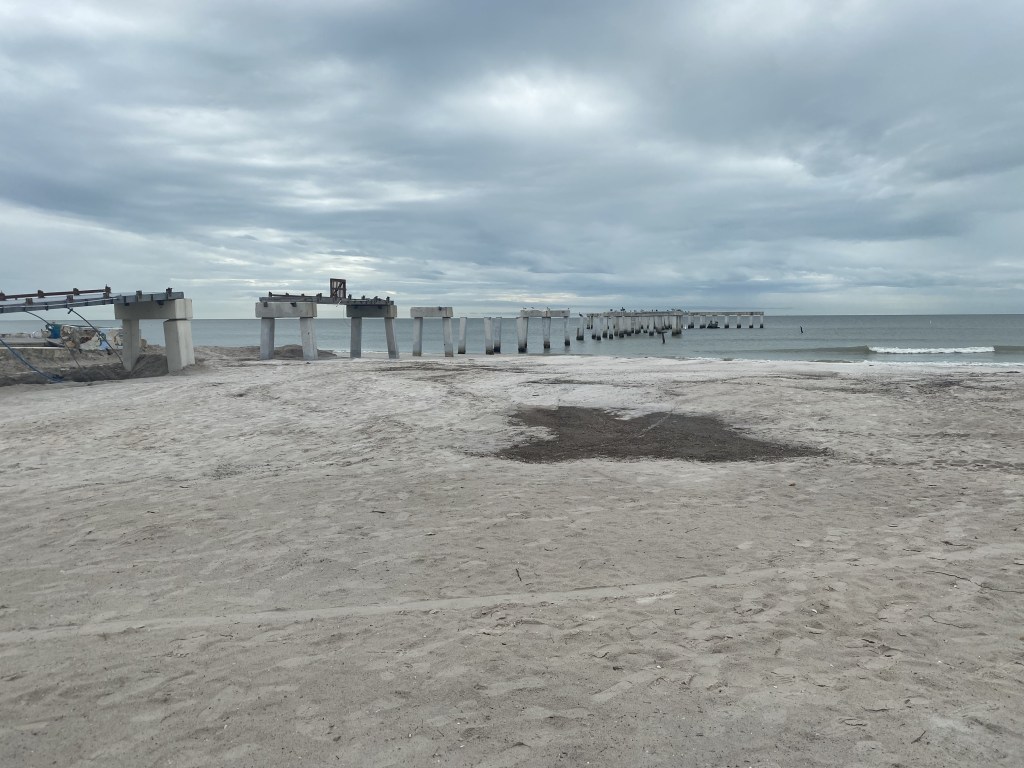
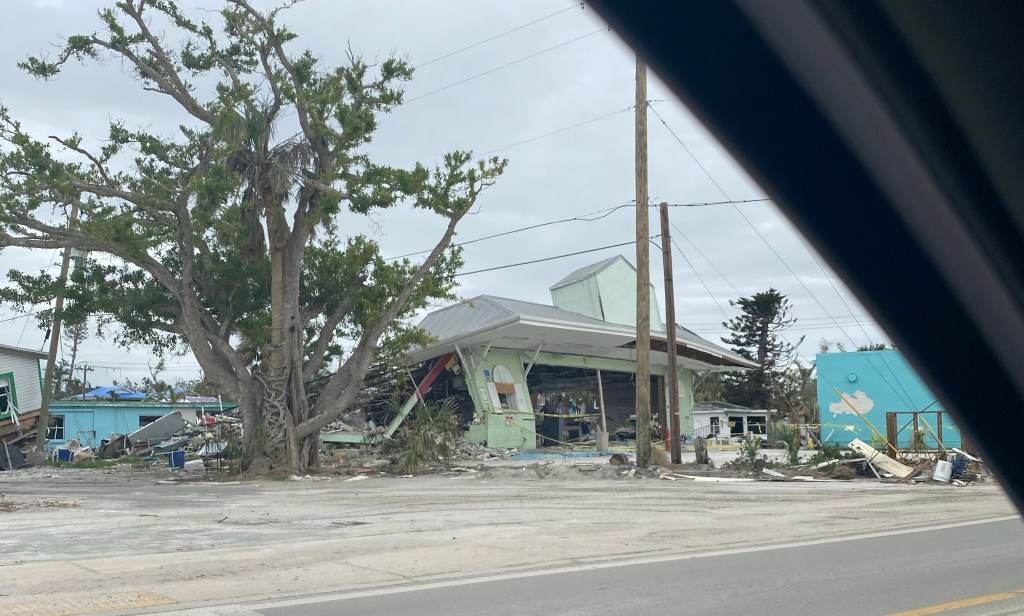
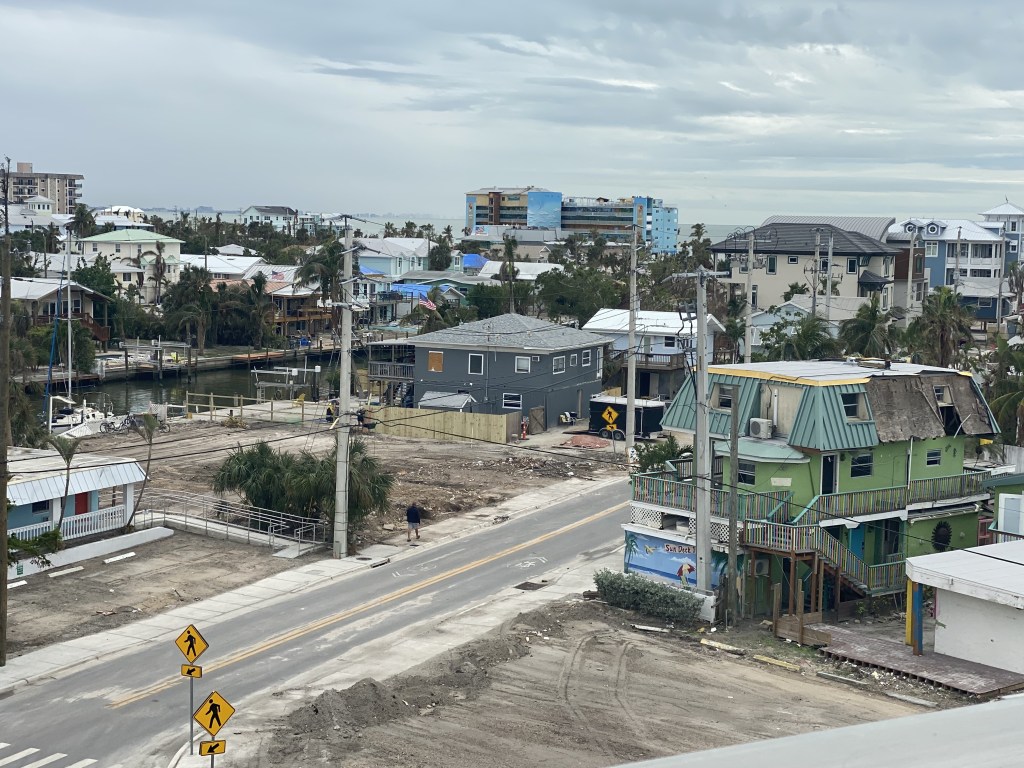
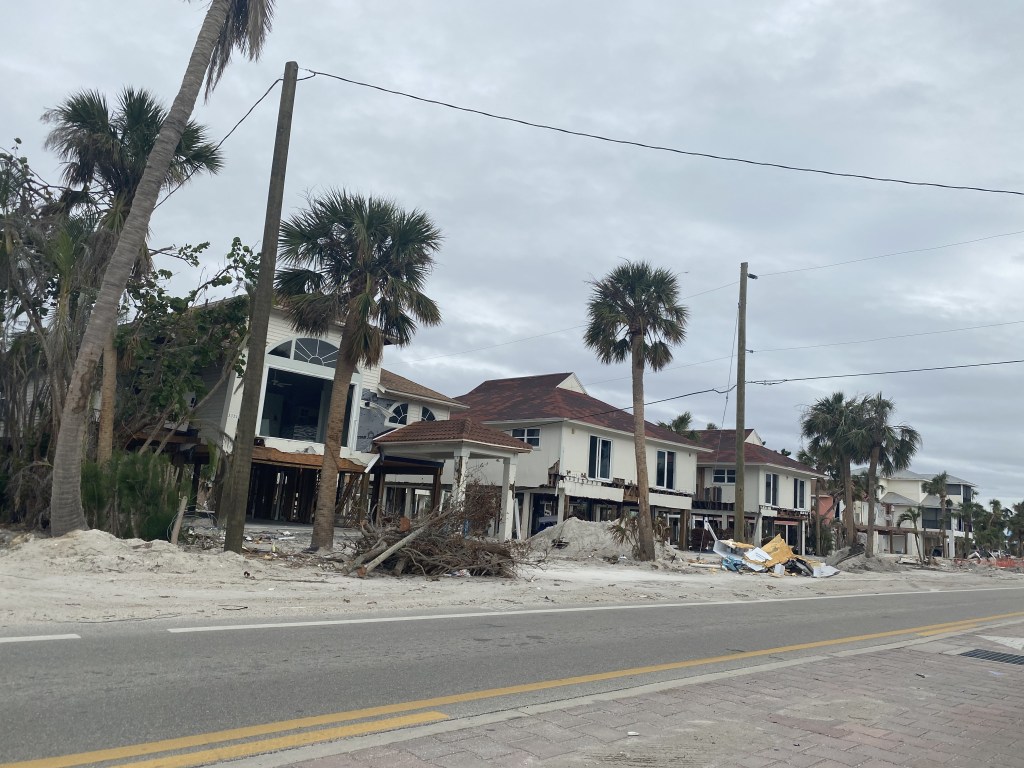
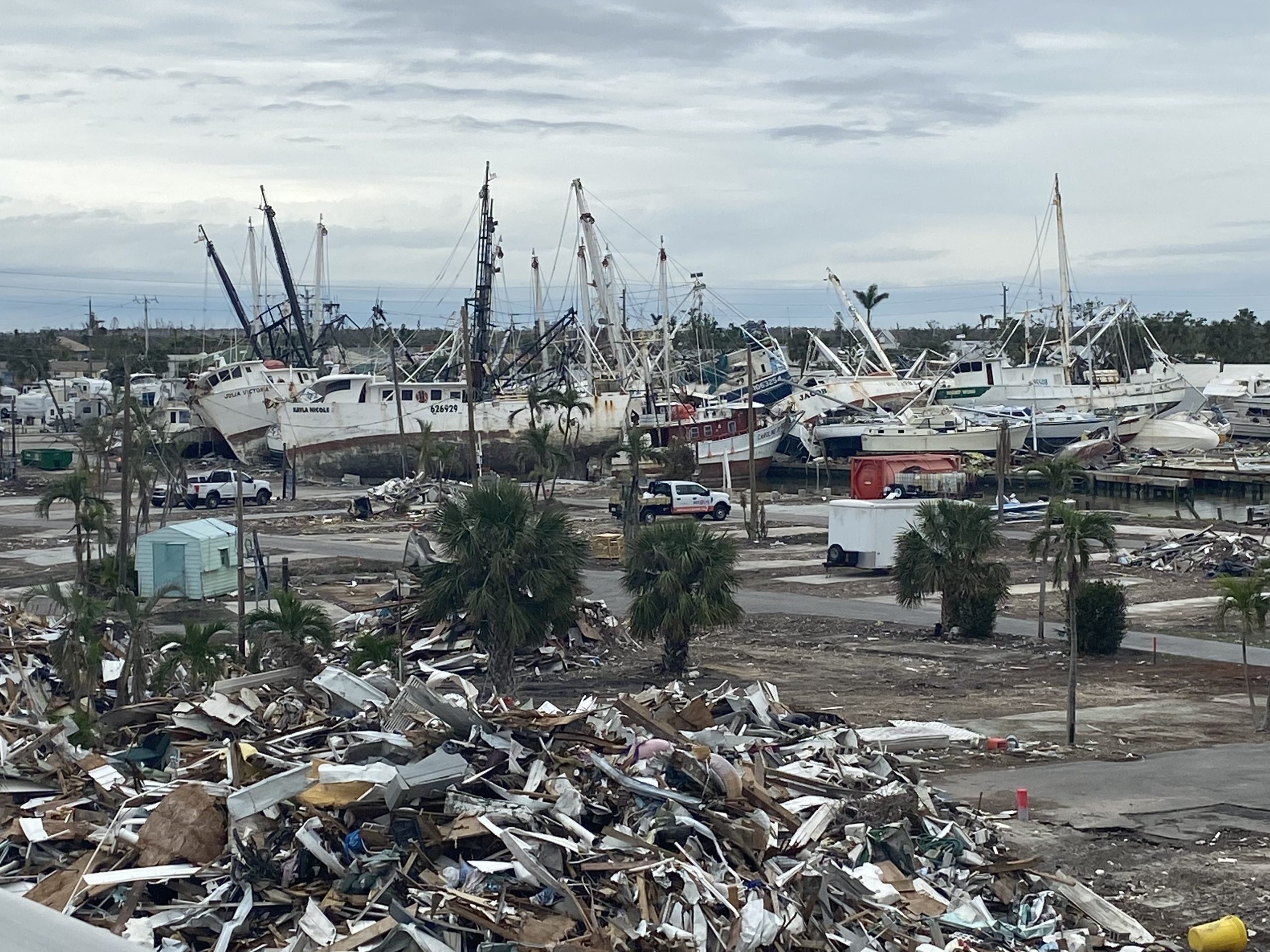
I expected the devastation. 

I knew that was the result of a category 4 hurricane and 12 to 18 foot storm surge. 

Weather.com footage of Hurricane Ian’s storm surge

What I didn’t expect was the emptiness. 

Every time I come over the Matanzas Pass bridge, driving or walking, the view over the top of Times Square draws me out to the beautiful stillness of the Gulf of Mexico. The sight brings a smile from deep inside me. 

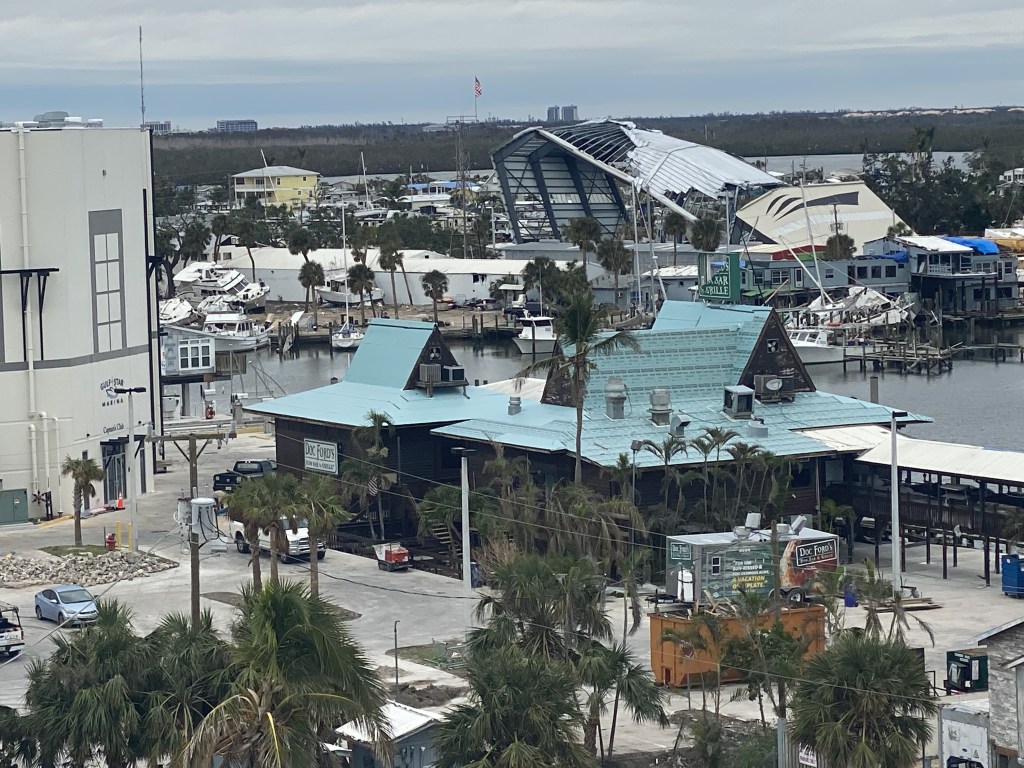
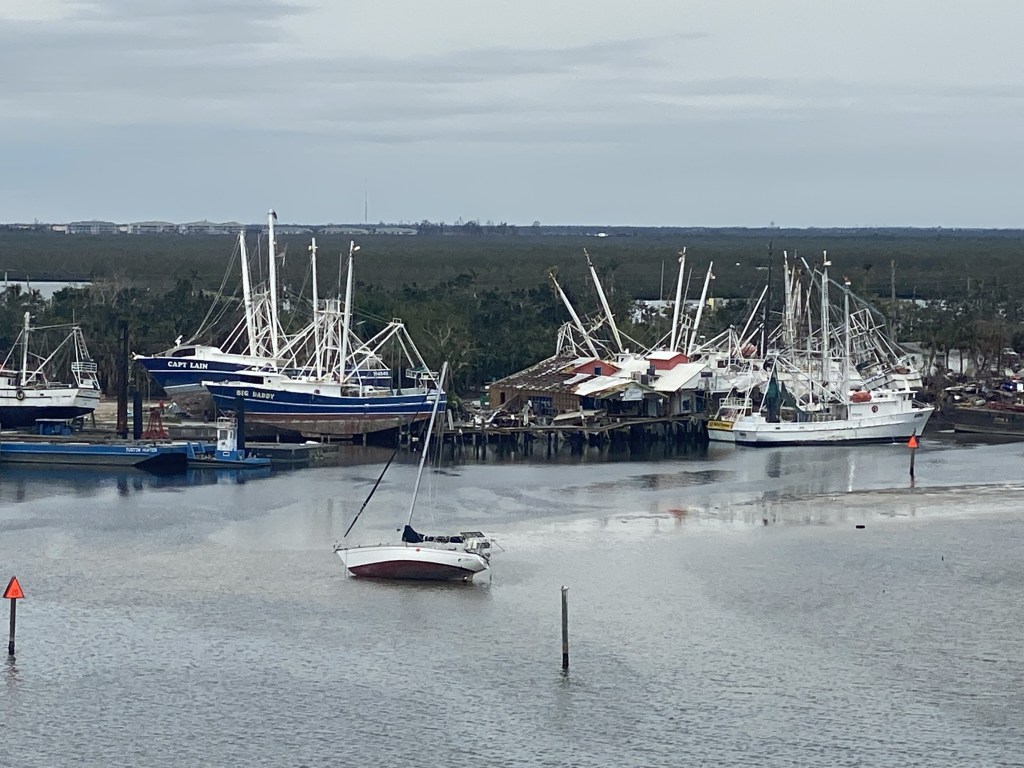
I’m always amazed at how much I love that view because I’ve seen it so many times. But this time, before we even started up the bridge, the sight of shrimp boats and docks piled up near the corner of the street completely disoriented me. The absurdity of seeing things that should be in the water on the street was total chaos. 

My mind couldn’t make sense of what I was seeing. I know these docks. I know these boats. Shrimp boats have been the backdrop to every memory I have of Fort Myers Beach. 

Science suggests that our first memories are from two to two and a half years old. In a recent article published in the journal Memory, Dr. Carla Peterson argues that the memories people can recall of things before the age of four are actually even earlier than they date them. So, when someone recalls a memory they think happened at age three, parents date that memory earlier in their child’s life. Dr. Peterson calls this telescoping.

“When you look at things that happened long ago, it’s like looking through a lens. The more remote a memory is, the telescoping effect makes you see it as closer. It turns out they move their earliest memory forward a year to about three and a half years of age. But we found that when the child or adult is remembering events from age four and up, this doesn’t happen.”

So, memories after the age of four are more concrete and accurately dated.

I absolutely know my first memories in life—I was four years old. I don’t remember my first words or the first book I read. But I know my first memories. They were of shrimp boats, docks, fiddler crabs, and sand spurs—all of those on the same day my parents moved us to the beach. 

The beach—then—was nothing like it has become in the last 10 or 15 years. Back then, there was more space between the houses to see the water as you drove down Estero Blvd. Instead of fancy mailboxes shaped like dolphins, there were palm trees, tropical shrubs, and white, dusty sand, all of it creeping onto the blacktop to make the road feel more like a jungle path than a street. Over the years, I’ve learned to still see these old, precious images despite the multi-million dollar homes that began to fill in the gulf side of the road with their driveways packed with Range Rovers and Audis even though their accumulation robbed you of the slightest glimpse of that beautiful water that you see from the top of the bridge. 

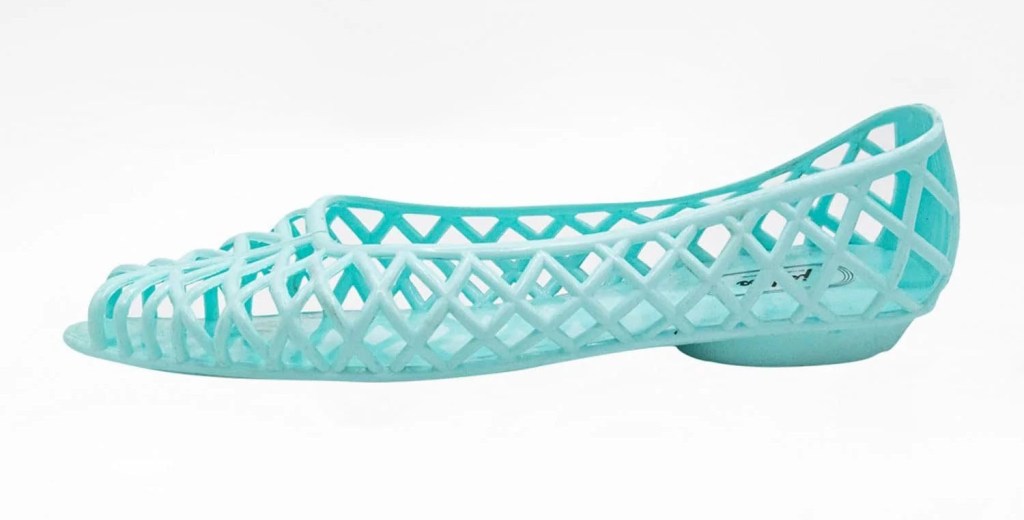
This change to my beach never bothered me because my mind is full of memories of walking that road before there were sidewalks, dodging palm fronds while the lava-hot sand slipped into my Jellie sandals. 

But at that moment, returning after the storm, it felt like I’d never been to this place. We parked in the first open area near Times Square and walked out to the beach. The hurricane was over but stepping from the car, I could feel the long-gone atmospheric pressure push all the air from my lungs. My breath was gone, and so was my beach.

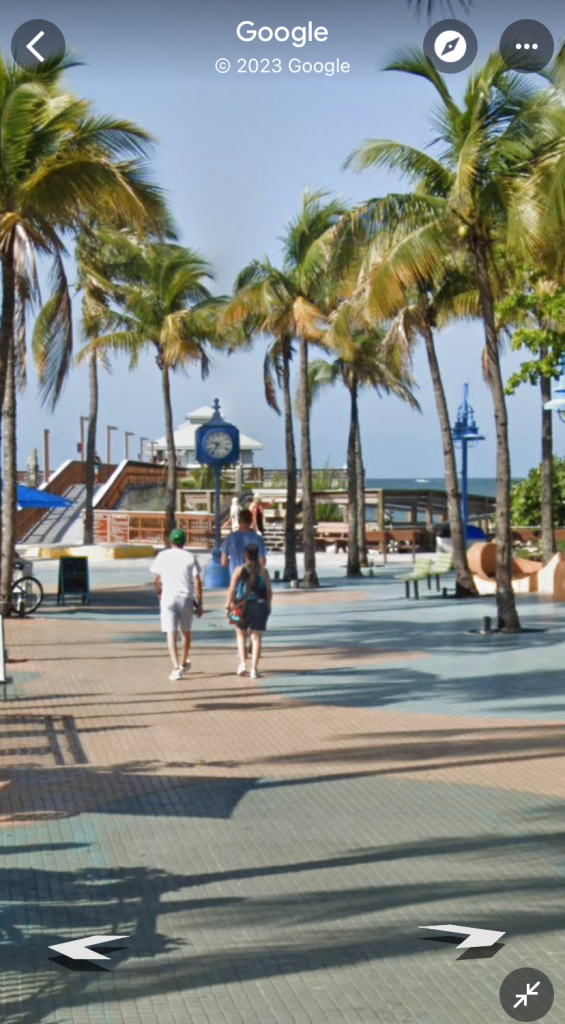
The emptiness was completely overwhelming as I stood on the sand, trying to focus on a pier that was no longer there. We stood exactly where we were one year ago, but my mind couldn’t make sense of what it wasn’t seeing. 

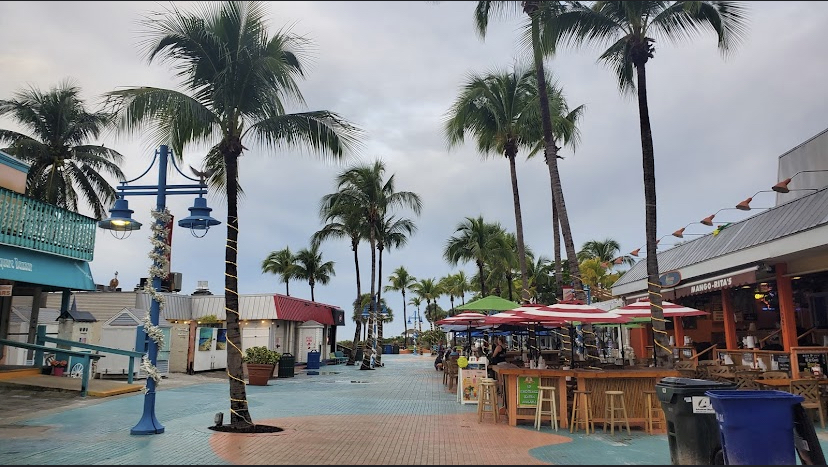
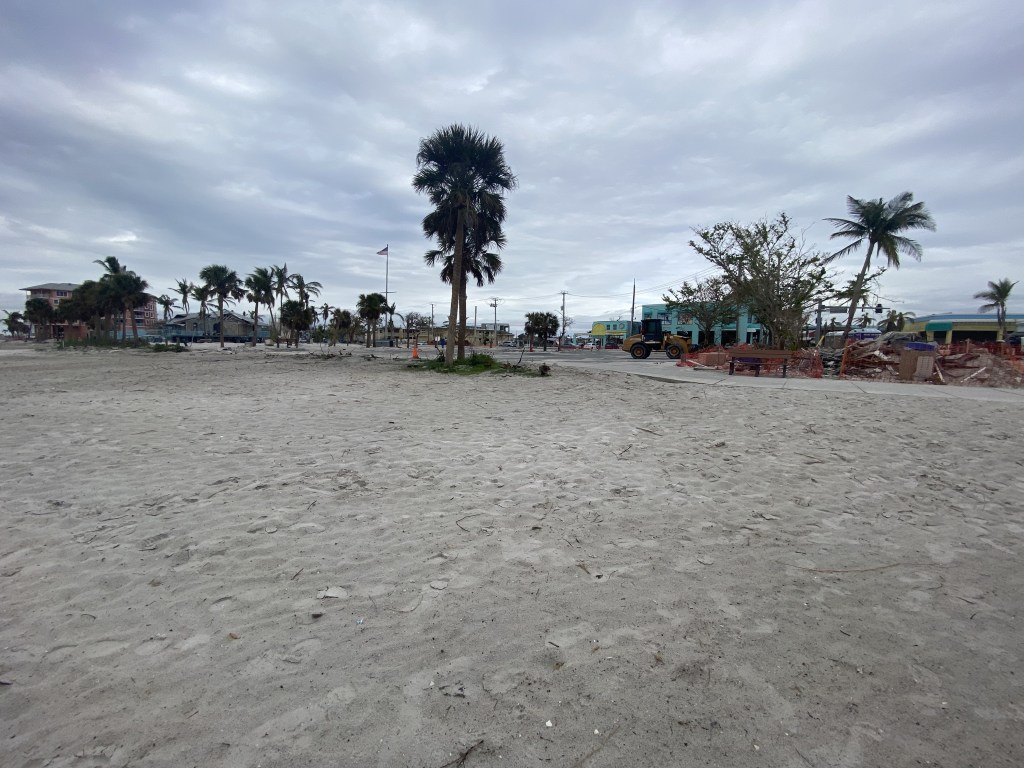
We walked off the beach and onto the pedestrian promenade that should have been bustling with tourists and locals. I looked around, and I couldn’t recognize anything.

I stood in the street outside of what should have been Plaka, home of the best breakfast on the beach, the same place we sat sweating in the shade eating last year. I turned to look down Estero Blvd at nothing.

I saw nothing because there was nothing. I tried to coach myself into seeing something— but there was nothing. This spot that always sparked a stream of memories could no longer shift me from the now to the then. I closed my eyes and forced the storm weight off my chest and drew air back into my lungs so my mind could focus, employing every meditation skill I could. Slowly, the back of my eyelids became the dark holes of a red plastic Viewmaster. My mind began to click through fuzzy, sienna-toned images. Floats in the annual shrimp parade. Girl Scout cookie tables at Winn Dixie. Late night, steamy summer walks to Andretti’s Pizza. The cold gush of air-conditioned air at 7-Eleven. My name in the sidewalk at Beach Elementary. My dad, with his white t-shirt and jet black hair hunched over a blue and white upturned boat, a lit cigarette between his lips and the stinging smell of fiberglass and resin in the air. Popsicle stick crosses from bible school at Chapel by the Sea. Bicycles with plastic streamers on the handles and salt air-rusted spokes. Star Wars at the theater in Santini Plaza. My mom, with bug, Hollywood-style rollers in her hair sitting behind the wheel of a faded tan Oldsmobile. The same Oldsmobile with steam gushing from the hood overheating in tourist traffic. Me in my terry cloth shorts and ribbed tank top, overheating in the back seat.  

When I opened my eyes, it was a rush of nothing. Emptiness. Once again, the sight of nothing overwhelmed me. I felt completely lost in a place I had known my whole life. 

No Dairy Queen. No Cottage. No 7-Eleven. 

This emptiness was all the missing landmarks that guide me through years of memories leading back to a childhood spent on this seven-mile stretch of sand, shells, shrimp boats, and sand spurs. The place that built me.

How will I ever find my way back there in all this emptiness? 

**Many of these photos were taken by Jason. But, I also copied some of these from Google maps. Thanks to those unfamiliar people (Janey White, Scott, Robert Mentecki, Ed Schmuhl, Andrea Pogue, Mr. Ed, Will Hayden) who posted these photos.

The Promise of Many Buds-Not a 4/20 Blog

I like to garden. I particularly like to garden from seed. There is something magical about seeing this tiny seed, like a cosmos seed for example, and watch it grow throughout the season. The entire plant cycle provides you with the opportunity to understand the circle of life. Because this little seed…

http://www.silverfallsseed.com

…will grow into this light, feathery plant…

http://www.gobotany.nativeplanttrust.org

…and produce these beautiful flowers…

http://www.floretflowers.com

…and then turn itself back into seeds.

http://www.weddingflora.com

It is truly amazing. What’s even more amazing is that it takes very little effort from me, once the seeds are planted, for it to complete this cycle. Provide an occasional watering if the weather is ornery. Use a support stick and a little twine if it starts to bend away from the sun or starts to fall. Give a little extra food to one or two plants if they seem to struggle. But really, in general, I find that plants genuinely want to grow. You just have to give them a safe and healthy place to do it. 

My love of gardening, and my role in it, mimics my professional life too. I like to take a small, new, curious thing and help it grow and help it reach its ultimate potential. Most students, like plants, genuinely want to grow. I make sure there is enough growing material n place when the semester starts. I show them where to start. I water them with encouragement. I provide the support if they start tilting away from the light. I feed them with other materials if they begin to struggle. But more than all of that, before they are planted, I spend my time creating a safe and healthy place for them to grow. 

Unlike my garden, students move on before I get to see them go to seed.  But there is something wonderful about being part of their cycle that allows me the chance to see these tiny buds of understanding form.

I like to think the end of my courses are like the month of June when gardens are green and full of life. There is a kaleidoscope of colors peeking out from the new buds, some just opening and some just buds pushing against their seams. The hope of a full bloom is my reward for those dormant weeks of mid-May when I wondered if I was doing enough for them, if there was something else I should be doing, and resisting the urge to overwater. 

“Don’t judge each day by the harvest you reap but by the seeds that you plant.” 

― Robert Louis Stevenson

My Existential Crisis

I don’t consider myself a particularly philosophical person. I am deeply analytical, and maybe that crosses the boundary somewhere. I can tend to overthink situations or things people say to me. But, at the end of the day, I rationalize most of my thoughts and feelings. To dwell in them and about them and then apply them to the way the world works would make me philosophical.  I don’t dwell on things beyond the day. Some beings are more contemplative….

Recently, I have been wondering if I will ever be able to be myself in Italy. It’s not the people or the community—they are extremely welcoming. But, as I study Italian, I do think about the very real fact that I will never speak the language well enough to express myself.  Am I prepared to live a life abroad with my abbreviated language skills? I am having a bit of an existential crisis.

The crisis comes after dealing with several scenarios here in Italy in which I required a translator to get the job done. We’ve managed pretty well in most scenarios. Like the two days we spent trying to get our cats’ their EU passports. Despite the language barriers, there was success.

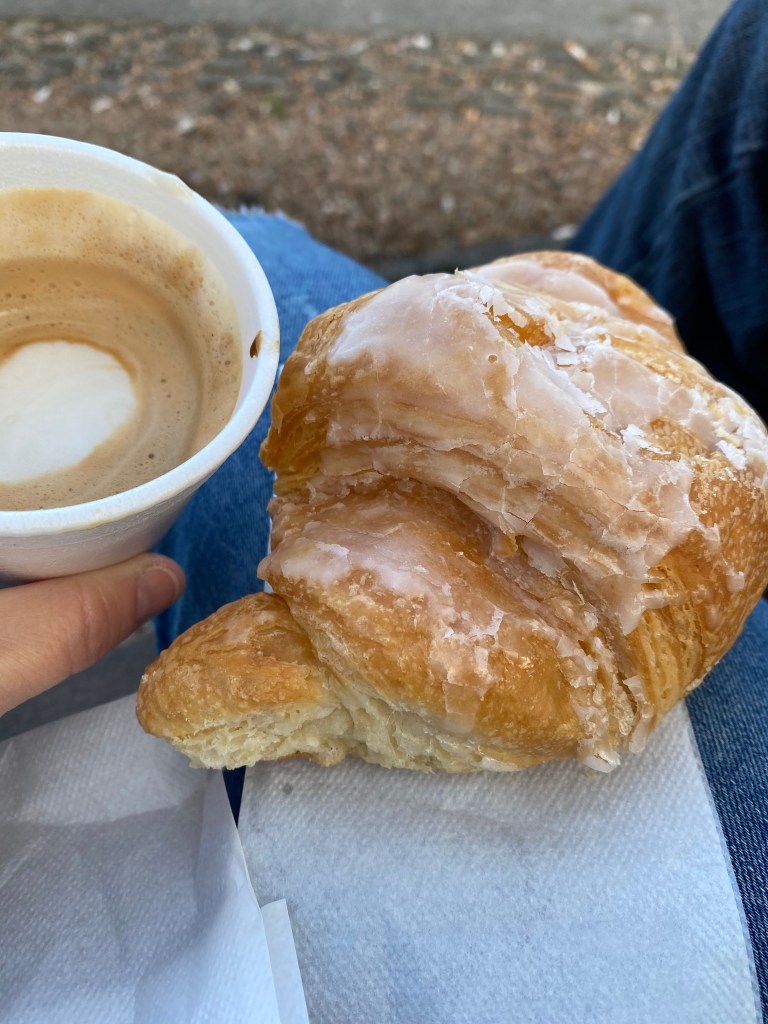
There is a small feeling of accomplishment with these successes too. At first, successfully ordering a cappuccino at the bar, or prosciutto at the gastronomia, was something to celebrate when we first arrived. Now, we stroll along the river and pop in anywhere for a coffee and cornetto and we don’t even think twice. 

But it’s different than contemplating your day lived through a translator. There is something about the inability to accomplish something without assistance. It somehow feels like less of a success. It makes you feel as if you are being removed from your own agency. Whoa…that’s too much. And I don’t think I’m in a group of oppressed people who are denied their agency. Let me try to get back on track….where’s the track?

I am thinking that without my voice I will never be able to be known to someone because of my language barrier. I am really good at expressing myself to people when I choose to. And, I am pretty easy to read. Anyone who knows me will say that my expression can relay exactly what I am thinking. It’s true. This quality has gotten me into trouble on more than one occasion. 

However, if you know me you know what I am thinking by my expression. Without knowing me, my expressions can be seriously misinterpreted.  So I think, for anyone I speak Italian with, they will likely never know me because the language prevents me from expressing myself.  Am I okay with being unknown or unknowable in my Italian life?

Actually, the truth may be that I know I will never master the language well enough to feel comfortable expressing myself.  And, that’s probably on me—probably.

I’ll need to keep those demons under control.

A Room with a View

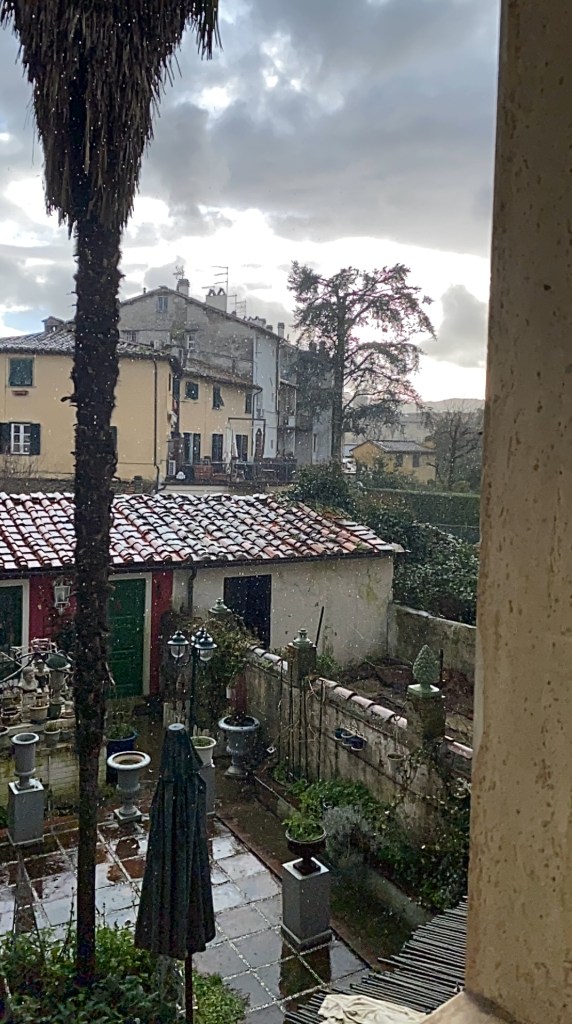
We have a great apartment here in Lucca. It’s exactly what we “need” with a few extras. What it doesn’t have is a balcony or a garden. We avoided getting one with those things because: 1) they are hard to find in Centro, and 2) I would be tempted to have the doors open constantly, and we were worried about the cats. But, I do have a great view from the guest room where I work/write/learn/study. 

I enjoy the view most of the time. Today, however, it annoys me. After a three hour Italian class this morning, I have come home to another long day of grading and posting and preparing assignments. The window is a constant reminder of where else I could be. I don’t want to be anywhere but here in Lucca—which is a drastic change for this queen of wanderlust. But, I also don’t want to be in this room doing work.

The sun is bright and the wind is, mostly, warm. My back aches from sitting all day. And I can’t focus on the screen of this laptop because the window draws my attention. Do I open the window? Will it torture me further? Likely.

I’ve worked hard to be here. Here in Italy. Here in Lucca. Here in this room. And there is a part of me that begins to harden at the thought that I am being denied the treasures that shine from outside this window. I’ve earned this, right??

I have always balked at the expression “You’re so lucky.” While I believe luck plays a part in life, we often confuse being “lucky” with “earned.” I’ve often heard college athletes remark in interviews before major playoffs (particularly NCAA Women’s or Men’s Basketball, because that’s really the only college sport I watch) say, “We are lucky to be here. And we’re going to make the most of it.” And I think to myself how that turn of phrase is so NOT what you are experiencing! You earned this! You worked for this! Lucky removes the agency from the action. To say you are lucky implies that you had no hand in getting there, and you have no hand in staying. You have no hand in winning. That court isn’t going to be a sunny day to sit back and enjoy! You want to be on that court; by God, you are going to earn every second.

As the sun goes in and out of clouds here in Tuscany, over this beautiful view, and the light filters in and out of this window, I also have to work for this too. If I want to be out there, by God, I have to earn every second. 

The sky has darkened a little and, as I adjust my eyes to the brightness of this laptop screen, I ask the cosmos for a bit of help to get back to work. I just need a little help somedays.

I am completely resigned to my work despite what comes through the window.

Oh, look…it’s raining. 

Monuments, and Museums, and Landmarks…oh my!

(Lions, and tigers, and bears…oh my!-Dorothy Wizard of Oz)

There are, of course, many differences between Europe and America. Obviously. But one notable difference is the very different feeling you get when you walk along the streets of Rome, Budapest, or Prague and when you walk along the streets of New York, Philadelphia, or D.C.

The sites—monuments, landmarks, and museums—in Europe feel different. This could be an American phenomenon. An American-in-Europe phenomenon.

For me, Ms. Wanderlust-So-Extra, the places in Europe feel inviting. They feel a part of the street, a part of the culture, and very natural, even when you don’t speak the language or understand the historical or cultural significance. These places feel more subtle than the attractions and the revered, untouchable tributes we have in the US.

The places in Europe, in my experience, invite you to come in, to smell the age, to listen to the stories, and the experience inspires you to go home and research them. These artifacts are presented in a way that represents a history of a people, of a culture, and of a time that no longer exists, but are meant to mark the existence–and your existence. 

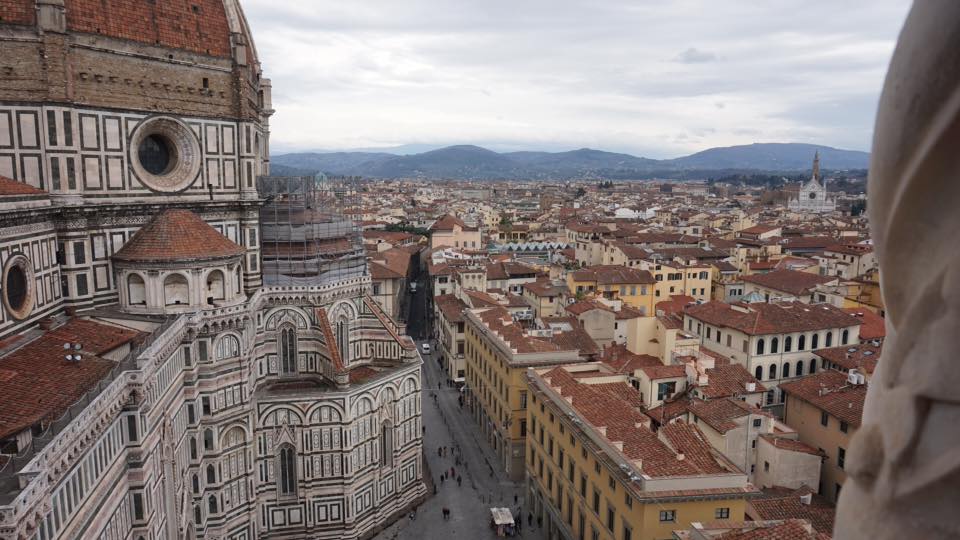
I think the recent controversy over statues in America has encouraged me to think more about why these places and artifacts in Europe feel different to me. That reflexive answer is that I am a tourist and these aren’t representing my history–thus the fascination. But, that’s not it. Because, when I really think about it, they ARE my history. The Duomo in Firenze, Italy is my history too. 

Photo Credit: Jason White 2018

The Duomo is a story of the Medici family and their desire to honor God and to use their wealth and power to build a monument that the Florentine people could call their own. It’s the story of Brunelleschi, an architect, and engineer, who believed that the structure could exist even when no dome that large had ever been built. The Duomo is the story of the rebirth of a culture and a people after the devastating effects of the Black Death. It’s the story of human production and human creativity and human passion, and the capacity of the human spirit to believe in something based on nothing more than faith. 

Those are humanistic stories. They are universal stories.

Photo credit: Me 2020

It seems, to me at least, that this humanistic connection to artifacts is more accessible in Europe because so many of them represent a collective humanistic ideal or a historical moment rather than a single person.

Oh, single-person tributes exist in Europe too. You can’t go anywhere in Tuscany without being inundated by Dante Alighieri.

Photo Credit: https://www.neh.gov/explore/the-world-dante

But Dante is revered because he wrote The Divine Comedy (and he is credited as the father of the Italian language). The Divine Comedy is a story of Dante’s journey through the three stages of the afterlife. The narrative poem’s reception, and its popularity, make Dante the man and the artifact. 

The Divine Comedy wasn’t even accessible to most people because Dante chose to write in the vernacular language of the Florentine dialect. If you wanted to read it, you had to learn the language. And, the first English translation didn’t come out until 1814.

1814!!! America was already a new nation by then. 

While Dante’s work contains a commentary on the 14th century political climate in Florence, people across time and across cultures have connected to the larger ideals he also presents. Dante’s journey represents his struggle to understand how our lived-life determines our afterlife. While a first mention of that particular struggle might not resonate, the lasting appeal of the text proves it does. 

Christian Blauvelt points out in an article for BBC, “You may have never read a single line of The Divine Comedy, and yet you’ve been influenced by it.” Dante’s work evokes such punishing imagery of Hell that his words have the ability to generate anxiety even in the unbelievers. Blauvelt points out that the famous tagline “All hope abandon all ye who enter here” has been reused repeatedly in contemporary iconography: as the epigraph in American Psycho, a Pirates of the Caribbean ride, and in the immensely popular World of Warcraft game. While one may not believe in Hell, the warning Dante created applies to larger imaginings of “the-most-awful-place-ever” in everyone’s mind.


Screenshot from Dante’s Inferno video game (https://www.npr.org/templates/story/story.php?storyId=123500164)

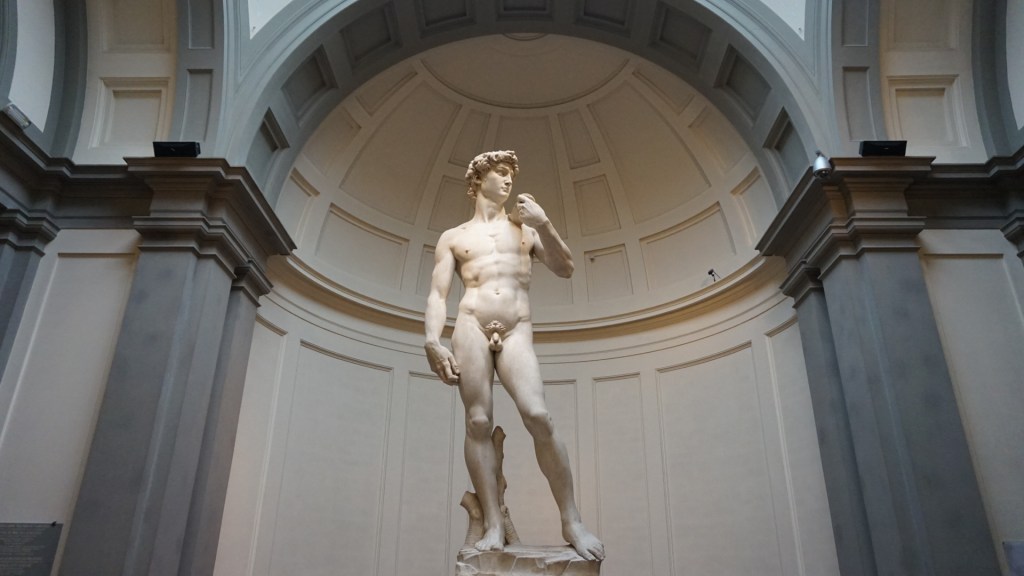
The same can be said of Michelangelo’s sculpture of David. When you stand before the 17-foot-tall statue and look up, it’s impossible to see anything other than the amazing expression on David’s face. He has a look of determination that is backed up by the ease in his confident stance. It’s as if his whole being is focused on succeeding. The desire and determination to accomplish something is a very, very real human story. We can all relate to the excited but anxious feeling of accomplishment. The look on David’s face and his posture reflects that human emotion. That very emotion we have all felt.

 The first time I visited the sculpture, I knew that this was what the Italians call, sprezzatura. 

Photo Credit: Jason White 2018

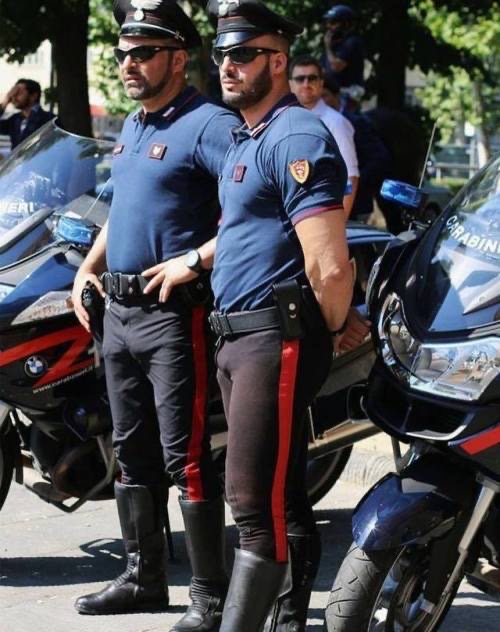
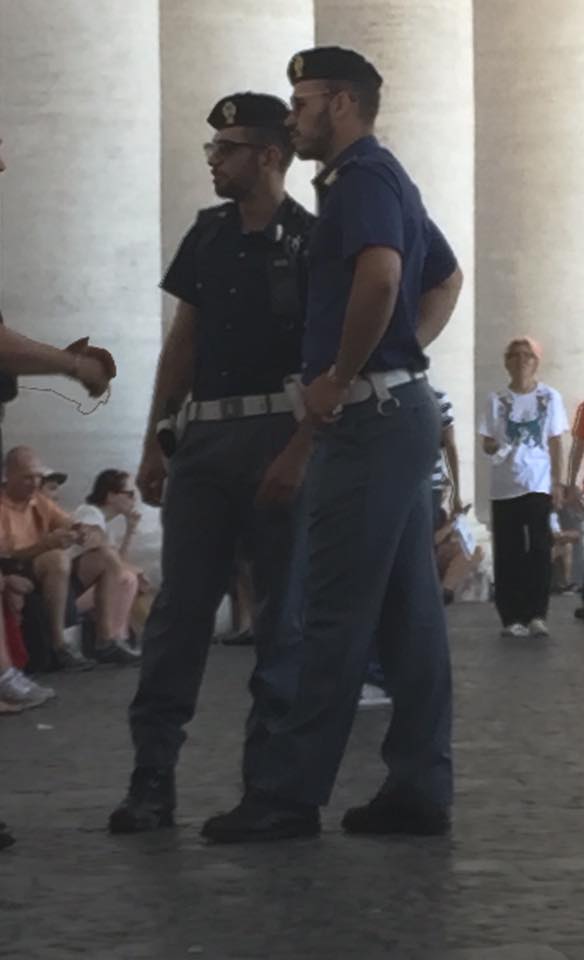
Though the sculpture was created in 1501, the term sprezzatura is defined, in 1528, by Baldassare Castiglione in Book of the Courtier as “a certain nonchalance, so as to conceal all art and make whatever one does or says appear to be without effort and almost without any thought.” (https://www.thelocal.it/20190121/italian-word-of-the-day-sprezzatura) While sprezzatura may not be something felt by everyone, as a human I can certainly appreciate the concept! And you’ll never look at the Carabinieri the same once you’ve seen David and you’ve heard the term sprezzatura.

(On the left, I don’t know where I got it (**internet wonders), but the one on the right is one my Mom and I took outside of the Vatican 2015).

Attenzione! Even for the non-reader, the unbeliever, the non-traveler, the non-Italian speaker, The Divine Comedy is a humanistic story. Michelangelo’s “David” is a humanistic story. It is YOUR story. And you can visit this history at the Accademia, at Dante’s home, and at the church he attended. At the Santa Margherita de’ Cerchi (known as Dante’s Church) you can leave a note of prayer for Beatrice (Dante’s love in real life and in the poem) to seal your love. And when you go, you will feel welcome. Dante and David, like so many other monuments, landmarks, and museums in Italy, tell your story—the history of being human.

P.S. stop next door to the church at one of the friendliest, places for a cocolli and a 2 euro glass of wine. 

Article by Christian Blauvelt:

https://www.bbc.com/culture/article/20180604-dante-and-the-divine-comedy-he-took-us-on-a-tour-of-hell

Cheers to the Stay-Puts

Photo Apr 01, 7 18 30 AMThe headline “Some Said They’d Flee Trump’s America. These People Actually Did.” appeared in the Style section of the Sunday NYT (April 15, 2018)–see the link below. A misleading headline (aka “Clickbait”) because the article wasn’t actually about disgruntled Americans bent on fleeing their homeland because of their fears over the (then) incoming administration. The article actually featured parents who seemed discontent with a multitude of things: trending consumerism, waning education, binary politics, healthcare, etc., etc.  The real story in the story was more interesting than the headline.

Regardless of their reasons, the article featured several families who were/are pursuing the nomadic life. I admire the family who trades their objects, pets, family, and familiarity for adventure, movement, placelessness, and travel. I admit that I could never have done that with my children. “Worldschooling” sounds great but I remember the basic struggles of parenting and I wouldn’t have willingly added homelessness to the mix. Not to mention, packing around MAYBE five sets of clothing means several days a month in a public laundromat. That’s not to say that my several visits to laundromats in Florence and Rome were horrid. In fact, I remember them fondly thanks in large part to the fiasco bottles of chianti that were just as important as the detergent.  Still, laundry is never at the top of anyone’s fun-list.

While the article was interesting, my main reaction was not of admiration or awe of these families. Several important things go unaddressed in the article by either the journalist or the families themselves.

Parents featured in the article commented that they worried about how their own busy work-lives would translate the wrong values to their children. One parent said her decision to “unplug from the Matrix” was a way to keep them from growing up “to be worker bees” and encouraged them “to be freethinking entrepreneurs” instead. This comes from a parent who claims to have been working 100 hours a week or more in her previous life running her own company. And then, in the next breath, says “Once I get my business up and running”…wait, that doesn’t sound like there has been a change in HER life. Wasn’t she doing this to the give up all the work hours in order to seize the moment? She goes on to mention that a nanny is part of her expenses. As a parent, and of the parents I know, the greatest part about dreaming of a different life is better time management in order to have the time to care for our children rather than leaving it to someone else. What seems obvious to me is that she is doing the SAME life/parenting she was doing in Seattle but she’s now doing it in on the move. She hopes her freethinking children will start their own YouTube channels and claims that she’ll “hire people to teach them how to do things.”…uhm, paying someone to educate your kids…did you learn that on your travels?

Under the sub-section “What It Costs” author Paul Kortman claims “a family could travel indefinitely on $60,000 a year, a salary he says could be earned with a little ingenuity”….oh, here we go.

There is a prevailing rhetoric in contemporary parenting that if you aren’t making it work, YOU must be doing something wrong without acknowledging class or privilege inherent in these trendy movements for alt-parenting. Kortman claims that all you need is a laptop and to “be an intelligent person” to make it work. Intelligence doesn’t get you a $60k salary per year.  In fact, several of the families presented in this article took savings, inheritances, and severance packages to build their nomadic life.

The article does not mention how long any of them have been doing this. My guess is that their intelligence will run out… Sorry! I mean their finances. When their intelligence runs out…sorry, finances run out, or the single-mom who is trying to start her own business can’t afford that nanny, or the photographer-mother who is hoping to monetize her social media accounts doesn’t get the payout she expects, these families will cope just like the rest of the parents in this world: they’ll learn to live on less or they will work more.

Parenting is a complex matrix of its own no matter where you are parenting. And essentially these parents are doing is limiting their children’s exposure to things they approve of, or limiting their children’s experiences to those they construct for their children.

Aren’t we all doing the same thing with the resources we have?  One parent commented that after living in Chile she appreciates “how much we have in the U.S.” How much you have? You mean all that stuff these parents claim they want to distance themselves from: consumerism, political systems, healthcare? Let’s remember that nearly half (43% according to the National Center for Children in Poverty) of American children live in a low-income family. Who is she referring to when she says “we have in the U.S.” 

So, shout out to all those stay-put parents making low-income life work and creating a constructive experience for your kids with the environment you have. And, for doing the laundry.